
Alexander The Great
Nurlan's Anthology of the Greats


Born to Philip the Second of Macedonia, Alexander was destined for greatness from the moment he graced the earth. Known as one of the greatest conquerors in human history, he has already conquered most of Eurasia by the age of 32. His childhood was teeming with political enemies, murders, suicides, trickery, and deception, the usual for princes back in the day. Nevertheless, Alexander kept pushing on and began showing his prowess in battles and the education from the help of his mentors, Aristotle and Leonidas, as well as his mother Olympias. When he was 13 Alexander was challenged by his father to tame an untamable horse, once he did, the horse accompanied him on every one of his journeys till his demise. By 18 he had conquered Europe when he took over his father's Hellenistic empire consisting of all the Greek states. He then began his march against what was considered the infallible empire- The Persians. Darius the Great had created an empire of such magnitude that not even the Athenians or Spartans could dream of conquering, with the now infamous tale of Leonidas’s Sparta being wiped from the face of the earth by Xerxes the Great with ease. The Persians were hated by the Greeks since the birth of the Achaemenid Empire and were considered the greatest in the world. Unfortunately, as with every empire, stagnancy and nepotism led to its eventual weakening. At the exact same time, the Persian Empire started weakening, and Phillip the Second began his conquest of Greece. Once Alexander took over, he saw the opportunity to conquer the Persians. Though his father's empire was the foundational building block for his eventual Alexandrian empire it only meant that he had to surpass the legacy of Philip the second. Phillip would have gone down in history as truly one of the greats if his son's brilliance didn’t overshadow that of his own. Philip was able to develop military technology which some attribute the be the core of the success Alexander was able to achieve. Phillip developed what became known as the Macedonian Sarissa Phalanx, considered the most ingenious military tactic of its time.
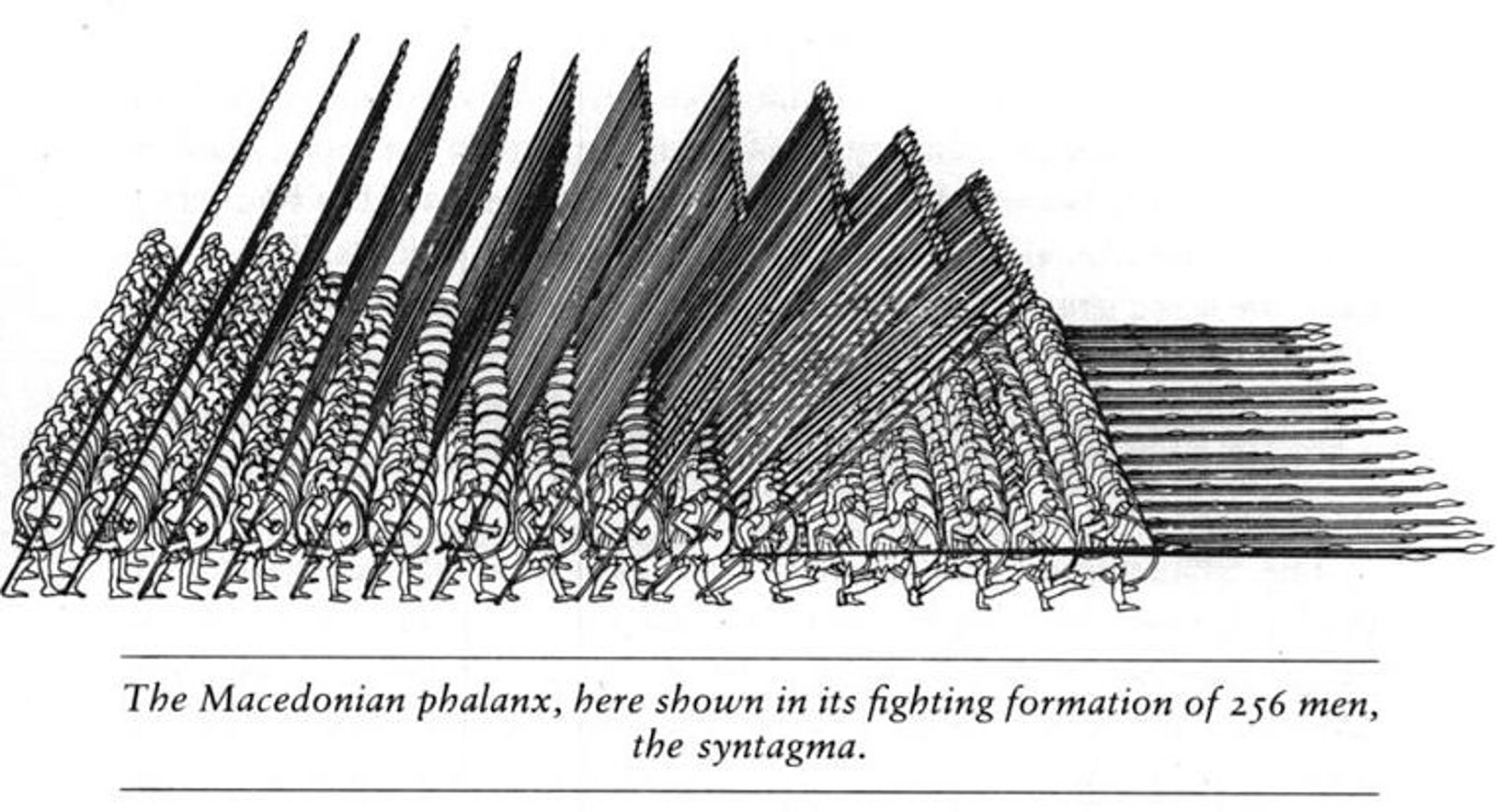
The Romans would later perfect it into the now infamous legion, a more flexible and structured formation that led to the domination of the Roman Empire. Nevertheless, the sarissa phalanx completely annihilated any and all that came across its path, with Alexander leading the charge, his enemies were at his mercy. Apart from the sarissa phalanx, Phillip also introduced the idea of elite troops, which further pushed his soldiers to pursue greatness. Alongside the sarissa phalanx, Alexander was invincible in battles due to his ingenious tactics and flexible strategies. He would utilize the cavalry and troops as separate entities, aiming to exploit the great parts of both, rendering his enemies useless. For someone so young his strategic mind was on par with ancient generals. Alexander was a man that was quite open-minded, adopting various cultures that he conquered along the way. Having married off most of his generals to Persian princesses in order to create a diverse and tolerant society, he was incredibly accepting of other cultures, which is even more surprising considering that Aristotle, his mentor, was a complete xenophobe. He was widely loved due to his liberality and the fact that he very rarely attacked any civilians in his conquests, choosing to rather adopt them as part of his empire. We can see just how forward-thinking he was by the fact that he employed both botanists and scientists in his army to study the lands he conquered, in order to gain a deeper understanding of them. His popularity led to him becoming “the chosen one” all over Eurasia and Africa, and the myths surrounding him in every culture are so numerous it is impossible to say which ones actually happened, such as the Gordian Knot. It's no surprise since the names Alexander and Iskander are so popular globally today, seeing his impact still echoes today. Unfortunately, the idea of “the chosen one” had a lot of negative impacts on Alexander, and while the mythos might have pushed his name into even further stardom, it did severely cloud his mind. I think what we saw with Alexander is similar to what we saw with Hitler, he began believing his own myth. His temper was notorious, and even though he opted to be a pacifist when it came to civilians, the genocide of Tyre serves as an example of how cold he could be. We also saw his rage in the Cleitus incident, where he murdered one of his closest allies in a drunken rage, some argue it was due to delirium caused by paranoia, alcohol, and disease, but no one sure. My personal opinion is that Alexander was a man with many demons, and just like his father, Phillip, was in a constant struggle with them. What didn’t help though was the egomania that started to develop over time, Greeks are notorious for loving democracy and hating monarchy, which is why when Alexander started being called “the king” and “the lord” there were a lot of issues within his men. He also made people kneel before him at a certain point which added fuel to the fire, even his infamous speech of Opis, which I adore, had an insane amount of narcissism and ego sprinkled throughout. His egomania started to alienate his allies from him, and the death of his closest friend (and potential lover) Hephaestion pushed him over the edge, which is why people suspect he was poisoned instead of succumbing to illness.
Why I Value Alexander
The reason I admire and respect Alexander is that even though the odds were stacked against him from the moment he was born, he persevered. One might water down his success due to the fact that Phillip II was so successful, but I disagree. Alexander had a mountain before him, and an unconquerable one at that, which was his father’s legacy. His father built the Macedonian Empire with his bare hands, and this incredibly imposing mountain that many princes before him faced, was one that put a smile on his face. Most princes achieve nothing because they are too afraid of conquering the mountain left behind by their predecessors, instead opting to live a life of comfort and debauchery, while expecting everything to come to them, since they have some sort of “heavenly mandate”. Instead of falling into the curse of nepotism, Alexander instead was inspired, where many faltered, he decided that a single courageous step towards the peak of it would begin his journey to greatness. By the time he was 18, he had already conquered all of Greece, all that was left was the rest of the world. What I admire about Alexander, was that he had only one ambition, conquering. While his governing skills were good, he wasn’t a ruler, he was simply a conqueror. Though he did show administrative foresight by mixing cultures and having diverse policies, the guy just loved winning wars. In all honesty, if he was born as a general instead of a king, I truly believe he could have achieved even more. There's a reason that his empire was so short-lived, because he honestly didn’t care about the admin stuff. Though I have a bias towards good rulers, as they seek to have a positive impact on the lives of ordinary people, I can’t not respect a guy who just liked fighting and lived it fully. The fact that he led every single one of his charges, proves that he did what he loved- conquering. Even though he died of a disease that was most likely caused by the injuries he endured by leading charges, I honestly think he had no complaints, he lived as he died. In my opinion, he died a man without regrets, conquering most of the world by his 30s, and truly pushing his body and mind to their fullest, he simply wanted to conquer the mountain left before him since birth and have his name ring throughout history.
Further Exploration
I went to an Alexander the Great exhibition at the British Library yesterday. Some of the quotes that stood out to me: “He who is to rule the whole world and bring all peoples under the power of his spear, will be the one who leaps on to Bucephalus and rides him through the middle of Pella.”- Oracle of Delphi to Philip II of Macedon. Greek Alexander Romance “Do you not think it is a matter for sorrow that while Alexander at my age, was already king of so many peoples, I have as yet achieved no brilliant success.” - Julius Caesar in Plutarch, Life of Caesar. “By the grace of great and glorious God our fortunes have prospered thus far. I wish to go to India and China and the farthest East.”- Alexander to Aristotle as reported in the Letter of Tansar I honestly didn’t really consider Bucephalus’ existence of great importance, but the exhibition highlighted just how much he meant to Alexander, and his myth. The exhibition highlighted just how important the myth or “Alexander Romance” was in building the idea of Alexander. Every single ethnic and religious group made their own versions of the Romance to somehow fit Alexander into their own history, even if he never even visited the country. It’s a testament to how the idea of Alexander became a tool to solidify power and legitimacy. There were a lot of fictional stories associated with Alexander as well, such as riding Gryffins, going to the bottom of the sea, and finding the Trees of Sun and Moon. The trees in particular were interesting, there was a quote that stuck with me: “You will never see your mother again, you have taken that ability from too many men to enjoy it yourself.” This perfectly summarizes his life. The law of equivalent exchange gave him a taste of everything at the expense of thousands of others and in turn took his life and all of his achievements at 32. I’d like to close off my study of Alexander with one of the admirable myths about him: Alexander and his men crossing the Gedrosian desert. His entire army was dying of thirst and hunger, to the point that men started killing their own horses. Due to their thirst, the moment they reached an oasis the men would drink the water too quickly, causing them to die of shock. Only a quarter of his army survived, but a part that stands out to me is when Alexander was brought water in a helmet by one of his soldiers “Alexander, with a word of thanks for the gift, took the helmet, and, in full view of his troops, poured the water on the ground. So extraordinary was the effect of this action that the water wasted by Alexander was as good as a drink for every man in the army. I cannot praise this act too highly, it was proof, if anything was, not only of his power of endurance, but also of his genius for leadership.”- Arrian.