
Ally Financial

Ally Financial Short
Ally Financial is an American bank holding company which I believe to be very hardly affected in the economic environment we are in right now. As I had also accurately predicted BlackRock dropping, I believe the same will be true today for Ally for many similar reasons. One of the main ways smaller banks that mainly rely on customer spending make money is through loans as there is also a big market for it, especially in America. However, from the recent interest rate increases, the demand has been significantly decreasing for it, also cutting into the bank’s revenues. Now let’s imagine that there weren’t any increases in the interest rates and everything was exactly how it was a year ago. The two main reasons people take out loans are to buy a house or a car. But that market has also significantly died down. Houses are now more unaffordable than ever along with most cars selling for as high as two times their retail price. So even if the interest rates hadn’t increased, there would still be a lower demand for loans as people simply won’t be able to afford them. This in return has also caused a big decrease in customers’ credit scores, making them ineligible for loans even if they wanted one.
Another reason why I believe Ally will do badly this quarter is due to inflation. Generally speaking, most businesses have been negatively affected by this whether directly or indirectly. One way banks have been affected by this is their customers being forced to spend more and therefore have less in savings. And clients taking out their money from their accounts is one of the bank’s biggest nightmares.
The third reason why I believe they will disappoint investors this quarter is because of the stock market. Another main way banks make money is through investing. Seeing how bad stocks have been doing this season, it seems impossible for Ally to have any positive returns, especially after seeing how BlackRock performed this quarter, missing the estimates by around $3B.
Lastly, none of these would make any sense if America was at the end of its recession and inflation was going down. But so far it seems to be the opposite as the economy is heading into a worse place and there are just no reasons for investors to long this company right now.
Analyst’s opinions:
Ally Financial Inc. on Tuesday said it has reached a termination agreement with Jennifer LaClair, who has served as chief financial officer of the digital financial-services company since early 2018.
In the last reported quarter, the company’s earnings lagged the Zacks Consensus Estimate. Results were primarily hurt by a rise in expenses, a decline in other revenues and higher provisions. However, an improvement in net financing revenues was an offsetting factor.
ALLY holds about 35 Billion in investment securities. These investment securities are marked to market each quarter. The majority of these held-for-sale investments are mortgage-backed securities. Since these are fixed rate obligations as interest rates rise their fair value falls. Over the first 6 months of 2022, the change in fair value of their held for investment securities has resulted in $3.7B of unrealized losses. This has been the main cause of the tangible book value of the company itself falling by $3B.
Q3 saw further increases in interest rate expectations. Based on declines in S&Ps mortgage-backed securities index during Q3 I expect ALLY will report around an additional $3B in unrealized losses. This translates to a tangible book value per share of $28.25, with the share count the same as the end of Q2.
Net interest margins are a critical component of how a bank makes money.
Increases in interest rates throughout the economy can put pressure on a bank's NIM. Since ALLY's deposits are interest sensitive the interest rate ALLY must pay to keep them has increased rapidly. While new loans that ALLY underwrites will be at a higher interest rate they'll need to wait for old loans to roll off their book to fully realize this benefit. As long as ALLY holds loans written at lower interest rates its NIM will be hurt.
As covered in the section on ALLY's tangible equity their investment securities are marked to market. This means that as interest rates rise, the book value of their investment securities will fall. However, the actual interest collected on their investment securities won't change. Since their value falls and interest earned stays the same these investments are effectively floating rate when calculating NIM.
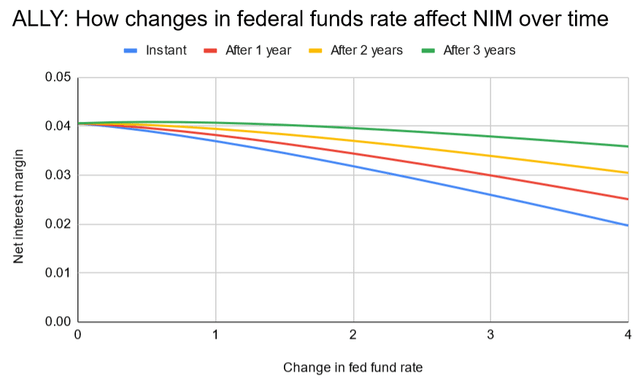
Using the above I calculated the effect of changes in the prevailing interest rates on NIM. The following graph shows the instant impact on NIM for rate changes along with the impact after 1,2 and 3 years after the interest rate increase.
I expect tangible common equity to be around 8 Billion at the end of Q3. This is a huge decrease from the 13.1 Billion in common equity that ALLY had at the start of 2022.
If interest rates continue to increase at such a rapid rate. ALLY would likely begin needing to retain more earnings to boost its regulatory capital. At the same time, ALLY's earnings would come under pressure from further NIM compression.
Report time: Tomorrow before the market opens
Expected movement: -4%
P/E Ratio: 4.17
Market Cap: 8,933,481,372