
Internal Rate of Return
Exploration Essay

Internal Rate of Return The internal rate of return or IRR is a strategy used in financial analysis to estimate the profitability of potential investments. Generally speaking, the higher an internal rate of return, the better the investment. IRR is used for all types of investments from big to small. In general, when comparing the investment benefits of one stock with the other, the investment with the highest IRR probably would be considered the best.
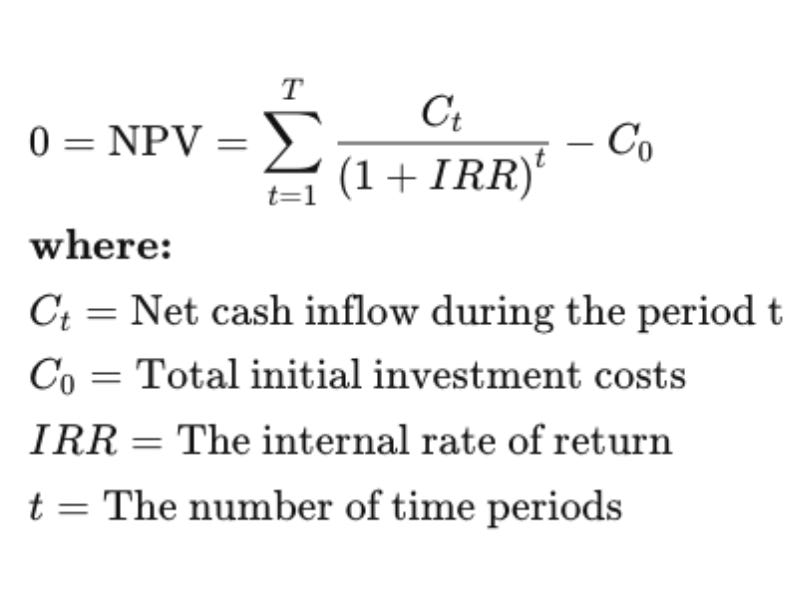
There is a certain formula that has to be followed in order to calculate the IRR. Using the formula, you would first have to set NPV equal to zero and solve for the discount rate, which is the IRR. Net present value (NPV) is the difference between the total money a company spends usually within a period of one year as compared to the total money they earn within the year. The initial investment is always negative considering the amount you have put into your investment, to begin with. Through this formula, you will be able to calculate the amount of money the company should expect to earn within the upcoming years. A simpler way of doing this could also be done through the tools available in Excel.

Here is a simple example of an IRR analysis with cash flows that are known for the next five years. This company is asking for an investment of 250,000 and in return, they are expected to generate 100,000 the next year and keep continuing to grow by 50,000 each for the next four years. The goal of an IRR is to calculate whether an investment into the company will be profitable or not or if the investor is getting a good deal on it. There are several other methods used in order to calculate a company's return, however, IRR is the most commonly used due to its accuracy. On the other hand, an investment will usually not have the same rate of return each year so even an IRR is sometimes not accurate. One of the most common uses of an IRR is to compare the profitability of newly founded projects and the already established ones. For example, an energy company may use IRR in order to decide whether they should open a new power plant or renovate and expand the one they already have based on the expected profits. While both projects may sound like a good idea, the IRR will identify which one can have the most expected profits. IRR is also a useful tool for corporations in deciding whether they should set buyback programs or not. By doing this, companies can figure out if buying back their own shares is the most profitable than any other use of the funds, such as expanding or acquiring other companies. Single individuals can also use IRR for their personal finances. For example, you can use IRR to evaluate different insurances based on the benefits that they have to offer. The cheaper the insurance is going to cost as compared to the benefits it has to offer, the better it will be. Generally speaking, any project with an IRR greater than its cost of capital should be profitable. In planning investment projects, firms will often require a rate of return (RRR) to determine the minimum acceptable return percentage. Any project with an IRR that is bigger than the RRR will likely be profitable, however, this isn’t the only criteria used to accept investments. What sets IRR apart from the compound annual growth rate (CAGR) is the fact that the CAGR measures the annual return on an investment over a period of time. The IRR is also an annual rate of return. However, the CAGR typically uses only a beginning and ending value to provide an estimated annual rate of return. IRR on the other hand involves using multiple periodic cash flows reflecting that cash inflows and outflows often constantly occur when it comes to investments, therefore, having a more accurate result. Companies and analysts may also look at the return on investment (ROI) when making financial decisions. ROI tells an investor about the total growth from the start to the finish of the investment and not the yearly returns. IRR tells the investor what the annual growth rate is. The two numbers normally would be the same over the course of one year but won’t be the same for longer periods of time. while IRR is a very popular strategy used for estimating a project’s annual return. It is usually not intended to be used alone. The IRR itself is only a single estimated figure that provides an annual return value based on estimates. Since estimates in IRR can differ drastically from actual results, most analysts will also use other techniques used to calculate profits in addition to IRR.