
Pioneer Natural Resources

Overview:
Pioneer Natural Resources is one of the largest independent exploration and production companies in the United States. The company produces exclusively in the Permian Basin, and it has the most extensive acreage of any company in this basin. It is located in western Texas. This sets them apart from their competitors as they have the highest amount of land and therefore oil to extract. The Permian Basin is a large sedimentary basin in the southwestern part of the United States located in western Texas and southeastern New Mexico.
The company carries out exploration and production in the Spraberry field which is located in Texas. To carry out its exploration and production, the company uses its own fracture stimulation fleets and other field service equipment that facilitate its drilling and production operations, including pulling units, fracture stimulation tanks, blowout preventers, water transport trucks, hot oilers, construction equipment, and fishing tools. It also owns interests in gas processing plants and treating facilities.
Understanding the company:
Petroleum is a dark-colored, thick crude oil found deep below the ground in certain areas. The name petroleum means rock oil. It’s called petroleum because it is found under the crust of the earth trapped in rocks. Petroleum is a complex mixture of compounds that is made up of only two elements, carbon, and hydrogen.
Formation of petroleum: It is formed by the decomposition of the remains of tiny plants and animals buried under the sea millions of years ago. Their dead bodies sank to the bottom of the sea and were soon covered with mud and sand. Due to high pressure, heat, bacteria, and the absence of air, these dead remains are slowly converted into petroleum. The petroleum formed then gets trapped between two layers of rocks, forming oil deposits.
Extraction of petroleum: It is extracted by drilling holes in the earth’s crust, where the presence of oil has been predicted by special machines. The oil wells are drilled by using drilling rigs. When an oil well is drilled through the rocks, natural gas comes out first with great pressure for a time and the crude petroleum oil comes out by itself due to the gas pressure. After the gas pressure goes away, petroleum is pumped out of the oil well.
Natural gas: It is found deep under the crust of the Earth either alone or along with oil above the petroleum deposit. Some wells produce only natural gas whereas others produce natural gas as well as petroleum oil. It is formed under the earth by the decomposition of the vegetable matter lying underwater. This decomposition is carried out by anaerobic bacteria in the absence of air.
Advantages:
It is a good fuel because it burns easily and produces a lot of heat.
It burns with a smokeless flame and causes no air pollution.
It does not produce any poisonous gases on burning.
It does not leave any residue on burning.
It can be used directly for heating purposes in homes and industry.
It can be supplied to homes and factories through a network of underground pipes and this eliminates the need for additional storage and transport.
Uses:
It is used as domestic fuel and industrial fuel.
It is used as a fuel in thermal power stations.
It is used as a fuel in transport vehicles. It’s a good alternative to petrol and diesel in vehicles because it is a cleaner fuel and does not cause much air pollution.
It’s a source of hydrogen gas needed to manufacture fertilizers. When natural gas is heated strongly, the methane present in it decomposes to form carbon and hydrogen. This hydrogen is then used to manufacture fertilizers.
Thoughts:
In my last report on Marathon Oil, I mentioned how oil firms have had a great quarter along with big estimates beats. However, I didn’t take into account what the future holds for them. Over the last 2 weeks, I have been closely watching different types of E&P companies and have noticed a common similarity. Even though most of them had a good quarter, the future forecast was looking the opposite.
There has been a sharp decrease in oil prices and they are expected to keep dropping. As fears of recession get bigger, investors rather invest in stocks that won’t be affected over the coming years and will always have a good outlook, one good example of this being food companies such as P&G. Furthermore, most, if not all big petroleum corporations have had a huge devaluation since January, even though their earnings reports were able to beat the estimates. Moreover, this proves that the markets are no longer the same and the outlook is the most important factor of any report.
In the words of Stanley Druckenmiller, it doesn’t matter what a company’s earnings is, you have to visualize the situation in 18 months. Now looking into the future, oil companies have already reached their peak and are starting to become devalued. One main thing that people look at is the probability of the upcoming recession which is going to have a huge effect on oil prices. In fact, currently speaking it is one of the main reasons why there have been price drops. However, something that already has been happening which I don’t see many people talking about is the reopening of China. They have now joined the game as their economy reopened and are importing oil at a much lower price.
This will create two massive shocks in the market. The lower prices now mean that the companies will try to undercut each other so that they can compete with China and convince customers to buy from them instead. However, what I believe will have the biggest amount of impact is the vast supply of oil that is now available. The main reason why petroleum prices began to climb, to begin with, was due to the limited amount that was available to consumers. Fast forward to the present time, E&P firms have been producing a record number of barrels of oil per day and now there is also China joining them.
I believe the points mentioned above will also have an indirect effect on them by lowering the overall demand for oil. Considering the wide number of options that consumers now have at very competitive prices, they are no longer limited to having just a few options to choose from which could cause many petroleum companies to lose customers or have a lower amount of oil bought from them.
So looking at 18 months from now, things aren’t looking too bright for oil companies. I assume that many firms have also spent a considerable amount of capital on increasing their capacity and speed of oil production which won’t be used to its full potential in the near future, making it a bad investment. As they say, all good things come to an end and the time for petroleum firms have come.
Disadvantages:
With current values and a high return on capital, Pioneer's outlook for 2023 now appears to be slightly more favorable. This implies that Pioneer's activities will ensure that plenty of money continues to flow even under the current circumstances. Investors may find the stock intriguing as a result, particularly those seeking a business that pays out significant dividends. In fact, the dividend yield being around 10.7% means that alone could send the stock slightly higher.
Pioneer has strong long-term fortunes regardless of what happens in the short term. Their assets are efficient, and their costs are likely to stop rising as quickly as they did previously. If oil prices go back to $90, investors may consider investing. On the other hand, if prices remain the same or drop, then it could be a case where holding the stock would be a better option where it still wouldn’t cause the stock to drop.
Pioneer Natural Resources is one of the blue-chip names in the industry. The company has a great management team, is run well from both a financial and operational perspective, and has a strong balance sheet and world-class assets. With the company's focus on the Permian, and over 20 years' worth of inventory of high-quality locations the company should be able to not only maintain production in the years ahead but also gradually increase production either through additional technological advancements such as their longer laterals or marginally adding locations.
Pioneer is really well run and is usually either leading the pack or near the front of it, when it comes to the industry and its peers making moves. Having ownership of great acreage helps, but the company has also kept the balance sheet strong and focused on shareholder returns. The key over the last two years has been the company's ability to operate without hedges like many of its peers, and the ability to take this path is due to the company's strong balance sheet and lack of a large debt pile.
These points are all very crucial factors when it comes to deciding whether a stock will increase or decrease after a quarterly report. Having a strong cash flow along with a low level of debt proves their ability to run a company successfully and have a strong foundation. However, after doing more research, I have come to the conclusion that when it comes to oil companies, investors have a different set of expectations.
Having a good balance sheet is a very positive factor for a company that has come out with a bad report by showing their financials to prove to investors that they have the resources it takes to turn the company around and have a good quarter again. However, the oil sector is bound to have a weak forecast no matter what financial position they are in. At the same time, having a large pool of cash is nothing short of an expectation as their revenues have tripled so it is therefore expected of them to have a strong balance sheet.
I strongly believe that these won’t be enough to satisfy investors into selling their current positions. One good way of imagining what an investor would feel would be by putting yourself in their shoes. Let’s for example imagine that you are sitting on a huge amount of profit on your Pioneer position and after reading their report, you see that they have mentioned having a weak future with a lower number of revenue and sales but also see that they have a strong balance sheet. At this point, this balance sheet won’t be important as no matter how much money they have, their revenue and dominance are still expected to which would cause their stock to also fall. So what most investors in this case would do is sell their position while oil companies are still at their peak and invest their money into a company where a recession won’t have any effects on them.
Competitors:
While nothing can be 100% proved, looking at how the other competitors in the same sector are doing can give you a clue on the sentiment around a certain stock. When it comes to Pioneer Natural Resources, they have five main competitors. Out of these group of stocks, Pioneer has been up just 33% over the last year, despite the soaring rise of oil prices. As a comparison, the company with the highest growth is up 107% while all the other companies have had at least a 40% growth.
This further proves that having large sums of cash isn’t everything when it comes to the growth of a stock. While it is a very big positive factor, it is meaningless if investors can’t make a profit on their investment, no matter in how good of a financial position the company is in. By Pioneer having one of the slowest growths between any other oil companies, there are much better prospects to look at when it comes to investing into the petroleum sector, making their strong balance sheet just an illusion.

Analysis: Revenues, Earnings Details, Free Cash Flow, And Oil & Gas Production

To put in perspective the revenues reported by Pioneer, it can be seen that there has been a constant revenue growth since 2020 based on the chart above. The reason why I find this important is that for this quarter, their revenue is expected to drop between 8-10% which is a very large jump. This suggests the fact that this company has already reached it’s peak and is expected to go down from here. I believe other investors to also have the same feeling as just on Friday alone, their stock dropped by 5% and at the time of typing this, it is down around 2%. This means that everybody is selling their shares before the quarterly report and taking whatever profit they have before they lose it. I’m expecting another sell-off after the report comes out.
Free Cash Flow
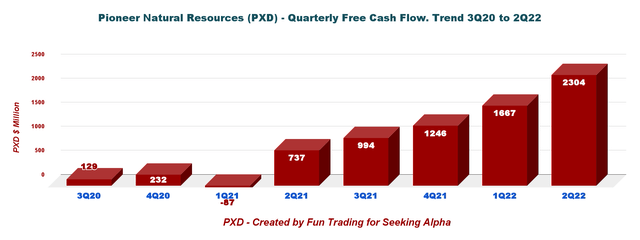
Along with the revenue, I believe their free cash flow is also bound to fall as oil prices have had a massive drop in value. As this will be the first drop in cash revenue since 2021, I find it to have a big impact on the stock price as investors have become extra sensitive to information that hints at a downfall of a company. In my opinion, cash flow is more important than revenue as most of the revenue gets eaten up by different types of fees. In reality, what companies use to invest back into themselves are explore new areas is their cash flow. So a drop in cash flow wouldn’t just mean a lower EPS, but it would also mean that they are much more limited in terms of improvements which could later result in a larger debt from borrowings.
Production:
As seen by the graph above, we can see a big increase in their oil production when the Ukranian invasion first happened, however, it is starting to decrease again. This further proves my point on the lower customer demand as the options are broadening. This also confirms a lower cash flow combined with decreased revenue.
Production Costs per barrel of oil:
A higher production cost also won’t be much of a help when it comes to their revenue. In addition to oil prices dropping, production costs are also increasing which cuts into their profit margins. These two combined can turn into a disaster for the company if not addressed properly. The graph above puts into perspective how fast their production cost is rising compared to last year. The production cost of each barrel of oil was $8 just a year ago but it has now jumped to almost $13 and is expected to keep growing.
SWOT Analysis:
Strengths:
They own one of the largest amounts of oil basins in the USA
They have a very large amount of cash in hand
They have a very strong cash flow and balance sheet
They’re known for their strong management team
The highest amount of dividends between any other oil company
Currently doing a $4B share buy-back program
Weakness:
Worst performing stock between other competitors
A growing amount of debt
An expected sharp decrease in their cash flow and revenue
A large number of people selling their shares in this stock
A quickly increasing cost of operations that is cutting into their revenue
Opportunities:
Expand into new parts of the USA for oil mining
Bring down production costs which therefore causes a higher profit and cash flow
Considering their cash equivalents, they can do a much higher amount of share buybacks
Threats:
A sharp fall in oil prices
China’s economy opening-up
A Lower demand and want for oil
A huge selection of oil companies for consumers to choose from
As fears of a recession increase, more people are shorting stocks with a bad outlook
Much more petroleum companies that are outperforming them and being a more attractive investment to buyers
Estimate:
I’m estimating a 3% decrease in their stock value after their report comes out. Something else that I have also realized looking at the stocks of different oil companies is that their overall trading volume has also decreased. This in return also causes a smaller percentage change. The bad forecast that investors are expecting also wouldn’t be much of a surprise so it won’t cause a massive sell-off. Based on their previous reports, 4% also seems to be the average movement after earnings so in addition to a lower trading volume and the expected results, I predict a 3% decrease.
Expected movement: -4%
Time: Wednesday after market close
P/E Ratio: 7.45
Market Cap: 49,648,631,248